
Why Dating Feels Harder With Anxiety
Anxiety and dating interact in ways that can make even a casual coffee feel like a high-stakes exam. Approximately 40 million adults in the United States - 19.1% of the population - experience an anxiety disorder in any given year (NIMH, 2025). For many of those people, dating is the arena where anxiety shows up most intensely, because romantic vulnerability activates the exact neural pathways that anxiety disorders hijack.
The pattern is familiar: you overthink every text message. You rehearse conversations for hours. You cancel plans at the last minute because the dread becomes physical. Or you show up and perform "normal" so convincingly that nobody notices the internal storm - which is exhausting in a different way entirely. Anxiety is one of many invisible disabilities that significantly disrupt daily life, alongside conditions like ADHD, OCD, and chronic fatigue, yet remain unseen by the people around you.
Here's what matters: these reactions aren't personality flaws. They're your nervous system doing what it was designed to do - protect you from perceived threat. The problem is that your brain has categorized "first date" alongside "genuine danger." The strategies below help you recalibrate that response so you can actually connect with another person.
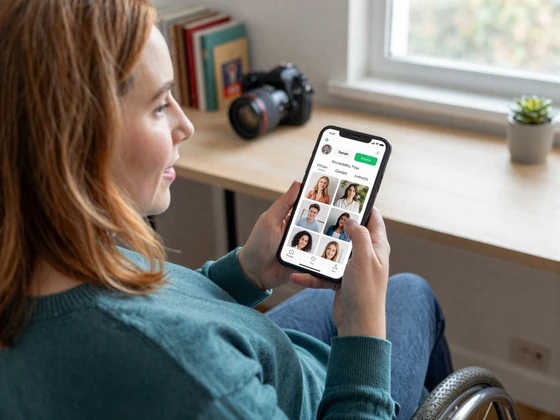
If anxiety intersects with another condition like PTSD or bipolar disorder, the dating landscape can feel even more complex. Our disability dating platform was designed to create a low-pressure environment where you set the pace and choose how much to share - before, during, or after matching.
Before the Date: Calming Your Mind
Pre-date anxiety peaks in the 2-4 hours before a scheduled meeting. That window is where most cancellations happen. These strategies target that specific window with techniques grounded in cognitive behavioral therapy (CBT) and somatic regulation.
1. Use the 5-4-3-2-1 Grounding Technique
Name five things you can see, four you can touch, three you can hear, two you can smell, and one you can taste. This sensory anchoring exercise pulls your brain out of future-catastrophizing and into the present moment. It works in under two minutes and requires no special tools.
2. Set a "Good Enough" Standard
Anxiety demands perfection. Counter it by defining "good enough" before you leave: "If I show up, stay for 30 minutes, and have one genuine conversation, this date is a success." Lowering the bar paradoxically frees you to exceed it.
3. Choose a Familiar, Comfortable Venue
Novelty amplifies anxiety. Suggest a place you already know - a café you've visited, a park you've walked. Environmental familiarity reduces the cognitive load your brain is processing, leaving more bandwidth for actual connection.
4. Prepare an Exit Plan
Knowing you can leave reduces the urgency of wanting to. Tell a friend your location and set a check-in time. Having a safety net makes you less likely to need one.
5. Move Your Body Before You Go
A 20-minute walk, stretching, or even dancing to one song metabolizes the cortisol and adrenaline that anxiety produces. Physical movement is the fastest way to shift your nervous system from sympathetic (fight-or-flight) to parasympathetic (rest-and-connect).

On the Date: Staying Present and Connected
Once you're there, anxiety often shifts from anticipation to performance monitoring: "Am I talking too much? Too little? Did that joke land?" These strategies help you redirect attention outward - toward your date - instead of inward toward your anxiety.
Focus on Curiosity, Not Performance
Prepare three open-ended questions you're genuinely curious about. When your brain starts scoring your performance, redirect it: "What's their answer? What do I actually think about that?" Curiosity and anxiety cannot coexist at the same intensity - curiosity wins when you give it a specific target.
Name It to Tame It
If anxiety spikes during the date, you have options. You can silently label the feeling ("This is anxiety, not danger") - a technique called affect labeling that reduces amygdala activation by up to 43% (UCLA, Lieberman et al.). Or, if you feel safe enough, you can say it aloud: "I'm having a great time, but I'm a little nervous - first dates do that to me." Most people find this disarming, not off-putting.
Give Yourself Permission to Pause
Silences aren't failures. If you need a moment, take a sip of your drink, look out the window, or simply breathe. People with social anxiety often interpret pauses as catastrophic - but research from the University of Groningen (2024) found that conversational pauses under 4 seconds are perceived as natural by the other person 89% of the time.
Plan Sensory Comfort
For people who experience anxiety alongside sensory sensitivities - common in neurodivergent individuals - choosing a quiet venue, sitting with your back to the wall, or avoiding peak hours can make the difference between an enjoyable date and an overwhelming one. Social challenges related to anxiety often overlap with autism-spectrum experiences, making sensory planning doubly important for neurodivergent daters.
"I used to cancel every date 20 minutes before. Now I tell myself: just show up for 30 minutes. I've never once regretted staying - but I've always regretted canceling."
- Sarah, 29, BeyondLimits member
OCD and Dating: Navigating Intrusive Thoughts
OCD dating challenges are distinct from general anxiety. Relationship OCD (ROCD) involves intrusive, unwanted thoughts about your partner or the relationship itself - "Do I really love them?" "What if they're not the right person?" - followed by compulsive reassurance-seeking. Approximately 2.5 million adults in the U.S. have OCD (ADAA, 2025), and ROCD affects a significant subset.
Recognize Intrusive Thoughts as OCD, Not Truth
The content of the thought is not the problem - the meaning your brain assigns to it is. "What if I don't actually like them?" is OCD asking for certainty in a situation that is inherently uncertain (dating always is). Practice labeling: "That's an OCD thought" - and then redirect your attention without engaging.
Resist the Reassurance Loop
Asking your partner "Are you sure you like me?" once is communication. Asking five times is a compulsion. OCD will tell you that one more reassurance will resolve the doubt - it won't. Each reassurance temporarily relieves anxiety but strengthens the cycle. Instead, sit with the uncertainty for 10 minutes and notice that the distress decreases on its own.
Separate OCD Doubts From Real Concerns
Real relationship concerns feel grounded and specific: "They were dismissive about my feelings during dinner." OCD doubts are vague, repetitive, and escalate despite evidence: "But what if I don't love them enough?" If the doubt sounds like a broken record, it's likely OCD. If it sounds like a clear observation with supporting evidence, it's worth discussing with your partner.
Work With an OCD-Specialized Therapist
Exposure and Response Prevention (ERP) is the gold-standard treatment for OCD, with a 60-70% effectiveness rate (International OCD Foundation). An ERP-trained therapist can help you design dating-specific exposures that gradually reduce the power of intrusive thoughts.
BeyondLimits feature: Our platform lets you set communication pace preferences - so matches know whether you prefer daily messages or a slower rhythm. For people with anxiety or OCD, controlling the pace of contact reduces the pressure to respond "correctly" and helps you engage authentically.
When to Reach Out for Support
You Deserve Help - And It's Available
Self-help strategies are a starting point, not a ceiling. If anxiety or OCD symptoms interfere with your daily functioning for more than a month, or if you're avoiding dating entirely despite wanting connection, professional support can make a meaningful difference.
- 988 Suicide & Crisis Lifeline - call or text 988, available 24/7. Veterans: press 1 after dialing, or text 838255.
- NAMI Helpline - 1-800-950-NAMI (6264), Mon-Fri 10am-10pm ET.
- ADAA (Anxiety & Depression Association of America) - therapist directory at adaa.org.
- International OCD Foundation - ERP therapist locator at iocdf.org.
In any emergency, call 911. You are not a burden for asking for help.
Consider therapy if you notice these patterns: canceling dates more often than attending them, spending hours analyzing text messages, experiencing panic attacks before or during dates, or using alcohol or substances to manage dating anxiety. A therapist trained in CBT or ERP can help you build skills that self-help articles alone cannot replicate. For people navigating anxiety alongside bipolar disorder or PTSD, a trauma-informed therapist who understands intersecting conditions is especially valuable.
You're Not Alone: Voices From Our Community
Dating with anxiety can feel isolating - but thousands of people on BeyondLimits navigate the same challenges every day. Here's what two of our members shared about their experiences.