
Understanding Deaf Cultural Identity - It's Not Just About Hearing
Deaf culture is a distinct linguistic and social community where American Sign Language (ASL) is the primary language, shared experiences form deep bonds, and deafness is viewed as a difference - not a deficit. According to linguists Padden and Humphries (2005), membership in Deaf culture is defined by self-identification and acceptance by other community members, much like any cultural group.
The distinction between "deaf" (lowercase d) and "Deaf" (uppercase D) is fundamental. Lowercase "deaf" refers to the audiological condition of not hearing. Uppercase "Deaf" refers to people who identify as culturally Deaf - they share a language (ASL), values, social norms, and a rich history of advocacy. Many Deaf people do not consider themselves disabled at all. They see themselves as a linguistic minority, much like Spanish or Mandarin speakers in an English-dominant society.
What does this mean in practice? When you date a Deaf person, you're entering a relationship with someone whose primary language and cultural framework may differ from yours. Neuroscience confirms this: research by Campbell et al. (2007) demonstrates that sign languages are processed in the same brain regions as spoken languages - they are full, complex linguistic systems, not simplified gestures.
This cultural awareness is why our Deaf community dating platform supports video messaging with captions, ASL-friendly profile videos, and communication preference filters that let users specify how they prefer to connect.
How to Communicate on Dates - ASL, Text, and Beyond
Communication on a date with a Deaf person involves more options than most hearing people realize. The key is flexibility - and asking your date what they prefer rather than assuming. Here's a breakdown of the most common approaches.
Face-to-Face ASL Conversation
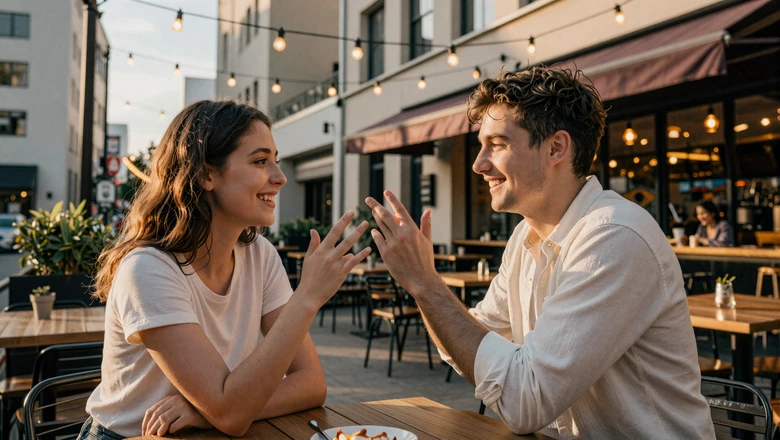
If your date uses ASL as their primary language, learning even basic signs demonstrates respect. You don't need fluency - effort matters. Many Deaf people are patient teachers and genuinely appreciate when hearing partners try. Position yourself so your face and hands are clearly visible, and never cover your mouth while speaking (many Deaf people lip-read to supplement visual cues).
Text-Based Communication
The notes app on your phone is your best friend during early dates. Many Deaf-hearing couples use a combination of signing, typing on phones, and writing on napkins. This isn't awkward - it's creative communication. Some couples develop their own hybrid system over time that blends signs, texts, and facial expressions into something uniquely theirs.
Video Relay and Captioned Calls
For phone conversations between dates, Video Relay Service (VRS) connects a Deaf caller with an ASL interpreter who voices the conversation to the hearing person. Captioned phone services (like CaptionCall) display real-time text of what the hearing caller says. Understanding these tools means you won't be caught off guard when your date suggests "calling" you.
Environmental Awareness
Lighting matters more than you think. Choose restaurants with good overhead lighting - candlelit dinners are romantic for hearing couples but create shadows that make lip reading and sign recognition difficult. Sit facing each other, not side by side. Ask for a table away from high-traffic areas where waiters might interrupt your visual conversation.
"My hearing boyfriend learned the sign for 'beautiful' before our first date. It wasn't perfect form, but it told me everything I needed to know about his character. Three years later, he's conversational in ASL."
- Deaf BeyondLimits member, Washington D.C.
Useful Sign Language for Dating - ASL Phrases to Learn
Learning these foundational ASL phrases before a date shows genuine interest in your partner's language. ASL is a visual-spatial language - these descriptions give you starting points, but watching video tutorials (search "ASL for dating" on YouTube) will help with proper hand shapes and movement.
| English Phrase | ASL Description | When to Use |
|---|---|---|
| Hello / Hi | Open hand wave near forehead, like a salute moving outward | Greeting your date |
| You look beautiful/handsome | Circle face with open hand, then close into a fist (meaning "beautiful face") | Complimenting your date |
| Want to get coffee? | Sign COFFEE (one fist grinding on top of the other) + point to date + raise eyebrows (question marker) | Suggesting a casual meetup |
| I had a great time | Sign ENJOY (both hands rubbing chest in circles) + MEET-YOU (two index fingers coming together) | End of the date |
| I'm learning ASL for you | Point to self + sign LEARN (pull knowledge from open palm into fist at forehead) + A-S-L + FOR + point to date | Showing commitment |
| Can I see you again? | Sign SEE (V-hand from eyes outward) + AGAIN (bent hand taps into open palm) + raised eyebrows | Asking for second date |
| I like you | Middle finger and thumb pull away from chest toward the other person | Expressing interest |
| Thank you | Flat hand touches chin and moves outward (like blowing a kiss from the chin) | Showing gratitude |
Pro tip: ASL grammar differs from English. Questions use raised eyebrows, and word order is often Topic-Comment (e.g., "COFFEE YOU WANT?" not "Do you want coffee?"). Don't worry about perfection - your effort communicates more than your grammar.
Date Etiquette When Dating a Deaf Person
Good date etiquette with a Deaf partner comes down to one principle: treat them as a whole person, not a communication challenge to solve. Here are specific guidelines that Deaf community members consistently recommend.
- Never shout or exaggerate mouth movements. Shouting distorts lip patterns. Speak naturally and clearly at normal volume - if your date lip reads, they need natural mouth shapes.
- Maintain eye contact. In Deaf culture, eye contact signals engagement and respect. Looking at your phone or glancing around the room mid-conversation is rude - it's the equivalent of putting in earplugs while someone speaks to you.
- Don't say "never mind" or "I'll tell you later." This is one of the most frustrating phrases a Deaf person hears. If they didn't catch something, rephrase it - don't dismiss it.
- If an interpreter is present, talk to your date - not the interpreter. The interpreter is a communication tool, not a participant. Make eye contact with your date, use "you" (not "tell her"), and direct all conversation to the person you're there to connect with.
- Choose accessible venues. Call ahead to check lighting, noise levels, and seating arrangements. A window seat with natural light facing your date is ideal. Avoid events where communication depends entirely on audio (concerts, loud bars).
- Ask about preferences early. "How do you prefer to communicate on dates?" is not offensive - it's thoughtful. Some Deaf people prefer voice-off environments; others are comfortable with a mix of signing and speech.
- Don't treat deafness as a tragedy or inspiration. Avoid phrases like "I'm sorry you can't hear" or "You're so brave." A Deaf person's life is full and rich - they're not missing anything. They experience the world differently, not less.
For more guidance on when and how to discuss disability-related topics in early dating, our article on how to disclose disability while dating covers the emotional and practical dimensions of these conversations.
The bottom line: dating a Deaf person isn't fundamentally different from dating anyone - it requires curiosity, respect, and willingness to meet someone in their world. Learn their language. Honor their culture. Show up with humility and genuine interest. The connection you build will be richer for it, because you'll have earned it through effort, not assumption. Ready to meet Deaf singles who are looking for meaningful connection? Our Deaf dating community on BeyondLimits supports video profiles in ASL, captioned messaging, and a community that values cultural identity.